

- today
- label News
- favorite 0 Likes
- remove_red_eye 15721 Visits
Woven fabric versus knit fabric – fundamental differences in the construction of spring clothing
The decision about the base for a new spring collection begins with understanding the fundamental difference in how the material is constructed. It directly affects the cut, the way of sewing and the final wearing comfort of the finished garment. Designers often face a dilemma between stability and elasticity, which determines the entire construction process. Understanding the mechanics of how a material is made lets you predict how it will behave during cutting and wear. Spring calls for solutions that respond to changeable weather and allow freedom of movement. The choice between interlacing warp and weft threads and forming loops is therefore a strategic decision for the functionality of a design.
Weave structure and its effect on the breathability of a material
The weave decides how air circulates against the skin, which is a critical parameter for transitional clothing. With woven fabrics, looser weaves such as gauze or loose plain weave allow air to flow freely but may be less durable. Twill weaves, although stronger and more crease-resistant, often create a more compact structure that limits breathability. For spring we are looking for balance. Open-weave materials provide excellent ventilation on warmer days but require precise finishing of the seams to prevent fraying. Examining the density of the weave against the light gives a first idea of a material's thermoregulating potential even before purchase. For spring collections, weaves that are not too tight are recommended, which lets the skin breathe while keeping the structure of the garment.
When should you choose knit fabric? Elasticity and comfort in light styles
Choosing a knitted material is justified in projects where the priority is a fit to the figure without restricting movement. High-quality knit fabric is made from one or many threads forming rows or columns of loops, which gives it natural stretch in all directions. This makes it indispensable for sewing fitted blouses, bodycon dresses or light wraps that have to work together with the body. Unlike woven fabrics, which need construction darts to achieve a three-dimensional shape, knitted materials can be shaped simply by stretching. This is particularly important in casual fashion and sporty elegance, which dominate the trends for spring 2026. It is worth remembering that the elasticity of knit fabric forgives small errors in sizing, which is an asset when selling ready-to-wear and reduces the risk of returns because of poor fit.
Dimensional stability of woven fabrics in projects with a complex cut
Woven fabrics outperform knitted materials in projects that demand architectural precision and a rigid shape. A construction based on the perpendicular interlacing of warp and weft gives minimal stretch, which is essential when sewing blazers, cigarette trousers or trench coats. Dimensional stability means that the finished piece will keep its shape through the whole day of wear and will not become deformed under its own weight or the wearer's movements. This is a desirable trait in office and formal wear, where a flawless shoulder line or a precisely pressed trouser crease testifies to the quality of workmanship. When designing complex details such as collars, cuffs or plackets, woven fabric gives certainty that the element will stay in place. When choosing a material for a spring jacket, look for fabrics with a dense weave that will hold the cut even without heavy stiffening interfacings.
Correctly identifying a project's construction needs at the stage of choosing the raw material eliminates most technical problems during sewing and wear.
A review of the best raw materials for the 2026 transitional season
The spring 2026 season brings a return to raw materials that combine a luxurious handle with high practical functionality. Customers are increasingly looking for clothes that not only look good but also actively support the body's thermoregulation in changeable weather. The market is moving away from cheap polyesters towards cellulose fibres and fine natural blends. Designers are focusing on materials that offer multi-season wear and durability, responding to consumers' growing environmental awareness. Analysis of the trends points to the dominance of three groups of raw materials that work best in light outerwear and dresses.
Viscose and modal knit fabric – hygroscopicity ideal for changeable weather
Second- and third-generation cellulose fibres such as viscose and modal form the foundation of modern spring collections thanks to their outstanding moisture absorption. Good-quality viscose knit fabric can absorb far more moisture than cotton while staying dry to the touch, which is invaluable during spring's swings in temperature. Modal, a variety of viscose with increased wet strength, is also characterised by exceptional smoothness and resistance to pilling. These materials are fluid, cool to the touch and give a high level of sensory comfort, which customers with sensitive skin appreciate. Spring dresses and blouses made from these raw materials skim the figure beautifully, do not build up static and keep the intensity of their colour even after many washes. It is a pragmatic choice, combining the elegance of silk with the ease of care that the modern consumer expects.
Fine linen and silk blends for premium collections
For the most demanding customers, who seek uncompromising quality, linen and silk blends are the pinnacle of achievement in weaving. Combining the rawness of linen with the sheen and softness of silk eliminates the flaws of both fibres, creating a material with unique properties. Silk gives the linen base a noble handle and reduces its tendency to crease sharply, while linen gives silk structure and breathability. Such a hybrid is ideal for exclusive jackets, trousers and cocktail dresses. This material has a subtle, uneven finish, which is a signature of luxury. In spring 2026 we are seeing a trend for using these blends in natural, undyed shades that emphasise the organic origin of the fibres. An investment in this raw material pays off in a product that ages gracefully and serves for years.
Mercerised cotton as the base of everyday outfits
Cotton that has undergone mercerisation is a material that takes on a completely new character, becoming an ideal base for premium casual clothing. The finishing process with sodium hydroxide smooths the fibres, increases their tear strength and gives them a subtle, satin-like sheen. As a result the material does not pill as quickly as ordinary cotton and takes dyes much better, offering deep, saturated colours. In spring collections mercerised cotton works superbly in the production of T-shirts, light jumpers and knit dresses. It is a more dimensionally stable material, which does not shrink in the wash as drastically as raw cotton. For the designer that means predictable production, and for the end customer a garment that looks like new even after many wash cycles. It is a safe, proven choice for basic wardrobe pieces.
Choosing the right raw material defines a product's price positioning and the target group the collection is aimed at.
Technical parameters of materials: weight, handle and finish
Beyond fibre composition, a project's success is decided by the measurable technical parameters of the material. They determine whether a dress will be airy or stiff, and whether trousers will be see-through in the sun. Understanding weight, handle and finish makes it possible to match the fabric precisely to a specific design, eliminating the risk of construction failure. In professional tailoring there is no room for chance; every parameter must work with the intended use of the garment. A spring wardrobe needs particular attention here, because the materials are thinner and lighter, which exposes any imperfection in the choice.
How do you choose the weight of fabric for a spring dress or blouse?
Weight, expressed in grams per square metre, is the basic indicator of a material's thickness and heaviness. For spring collections of light clothing the optimal range is usually from 80 to 200 g/m². Materials below 100 g/m², such as voiles or chiffons, are suitable for airy blouses and multi-layered skirts, but may need a lining. The 120-160 g/m² range is the most versatile for dresses, shirts and light trousers, giving adequate opacity while keeping lightness. Values above 180 g/m² in spring fabrics already suggest materials for jackets, light coats or trousers with a more structured form. Remember that the same weight with a different fibre composition will give a different feeling of heaviness – a linen of 150 g/m² will seem stiffer and heavier than a viscose of the same weight. The choice of weight must be closely correlated with the planned style.
Testing handle and drape – how the material falls in movement
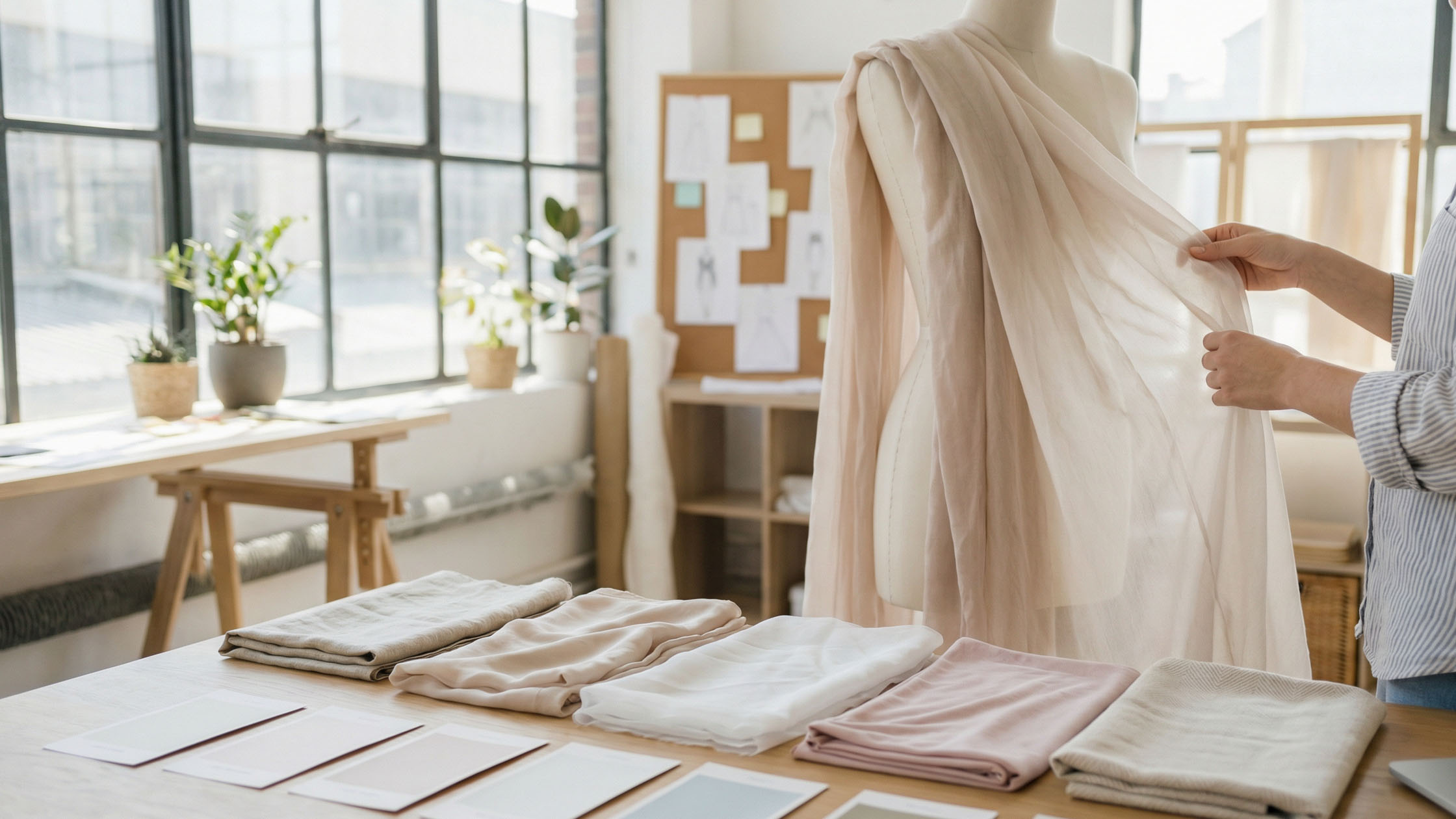
The handle of a material is both a subjective impression on touch and the objective ability of a fabric to fall under its own weight. Drape is crucial for designs meant to flow softly around the figure, such as dresses with draping or wide palazzo trousers. Materials with a soft handle, such as cupro, silk or good-quality viscose, create fluid lines and "work" in movement, giving the figure dynamism. Materials with a dry, papery handle, such as taffeta or raw linen, in turn create sharp, geometric folds and build volume, which is desirable in architectural and oversized designs. Before buying a larger batch of material, it is worth carrying out a draping test by pinning a piece of fabric to a mannequin. This lets you judge whether the material forms soft folds or sticking-out cones, which is decisive for the final visual effect of the design.
Transparency of lightweight materials and the need for lining
Transparency is a feature often desired in evening fashion but problematic in daywear. Low-weight spring materials with a loose weave naturally tend to be see-through, especially against the light. When designing a collection, you should decide from the start whether a given material needs a lining or whether its structure provides sufficient discretion. A lining not only solves the problem of transparency but also affects how the outer layer drapes and the wearing comfort, preventing the material from clinging to tights or the body. With knit fabrics, transparency may appear only when the material is stretched over the figure, which is a common construction mistake. Testing a swatch by stretching it over your hand in daylight lets you quickly check the degree of coverage and decide whether to double the layers.
Consciously handling technical parameters helps avoid disappointment and create clothing that is not only beautiful but also functional.
Sustainable fashion – natural materials versus modern synthetics
The discussion of ecology in fashion in 2026 goes beyond a simple division into "good natural" and "bad synthetic". Sustainable development means analysing the product's whole life cycle, from sourcing the raw material, through durability in use, to disposal. Modern textile technologies offer solutions that combine the advantages of both worlds. Customers are increasingly well informed and look for transparency about where materials come from. Choosing the raw material for a spring collection thus becomes a statement of the brand's values.
Why is it worth investing in certified natural fibres?
Certified natural fibres, such as GOTS organic cotton, European Flax linen or silk from controlled farms, guarantee that the production process was safe for the environment and for people. Investing in such materials answers the needs of conscious consumers who are ready to pay more for an ethical product. Natural fibres are fully biodegradable, which solves the problem of textile waste. In addition, their thermoregulating and anti-allergic properties are hard for chemical laboratories to imitate. Garments sewn from high-grade natural raw materials age nobly, gaining character with every wash instead of losing quality. This is a key argument in selling premium products, where durability and comfort are the overriding values.
Modern synthetic admixtures that improve the durability of knit fabric
Although synthetics have a bad press, a small admixture of modern man-made fibres can significantly extend the life of a garment, which is in keeping with the idea of slow fashion. Adding 3-5% elastane means that a cotton or viscose knit fabric does not bag out at the elbows and knees, keeping its original shape for a long time. Mixing a high-quality polyester or polyamide into wool or linen, in turn, increases abrasion resistance and makes care easier, often removing the need for dry cleaning. The key is proportion – the synthetic should play the role of a functional addition, not the base. In this way we keep the breathability and handle of the natural fibre, while gaining the mechanical strength that pure natural raw materials sometimes lack.
Ecological aspects of choosing fabrics in 2026
In 2026 ecology is not only about the raw material but also about finishing processes and logistics. Designers are increasingly choosing materials produced locally in Europe to shorten the carbon footprint of transport. Dyeing technologies that use less water become important, as does digital printing, which generates a minimal amount of waste. Recycled materials (upcycling) and innovative closed-loop cellulose fibres such as Lyocell or Tencel, where solvents are recovered almost 100%, are gaining importance. The choice of material for a spring collection should take these aspects into account, since they are becoming an important part of the marketing narrative and of building trust in the brand.
A responsible choice of materials is an investment in brand image and in a real influence on the future of the fashion industry.
FAQ – Frequently asked questions about choosing spring materials
Many technical and practical doubts arise when choosing materials. Answers to the most common questions help dispel myths and make better purchasing decisions. Customers and designers often ask about the use of specific types of knit fabric and ways of dealing with the natural properties of fabrics, such as their tendency to crease. This knowledge is essential for avoiding mistakes at the production stage.
Is sweatshirt fabric suitable for a light spring collection?
Yes, but only if you choose the right type. Classic brushed sweatshirt fabric with a fleecy "teddy" backing will be far too warm for spring days. Look for looped-back knit (French terry) of lower weight, in the range of 200-240 g/m². Such a material is breathable, lighter and sits better on the body while keeping the characteristic sporty style. It is also worth looking at sweatshirt fabrics with modal or viscose added, which are more fluid and cooler to the touch than pure cotton, which makes them an ideal choice for spring dresses, skirts and light sweatshirts.
How can you prevent linen clothes from creasing through the choice of weave?
Linen is by nature a stiff fibre prone to creasing, which some see as a flaw and others as a sign of naturalness. To minimise this effect, choose linen in a twill weave (e.g. linen drill) or a jacquard weave, which are more resilient and less prone to setting creases than a simple plain weave. Another effective method is to choose blends of linen with resilient fibres such as silk, wool or even a small admixture of viscose. A knit structure made from linen also creases far less than woven fabric, thanks to the looser arrangement of the threads.