

- today
- label News
- favorite 0 Likes
- remove_red_eye 1544 Visits
Denim and corduroy fabrics: the return of tailoring classics in the 2026 season
Why are they ideal fabrics for cold days?
The coming months call for the right solutions in your sewing room. Thicker weaves provide optimal thermal insulation on autumn walks. The compact weave of denim protects against the wind, and the ribbed structure of corduroy holds warm air close to the body. When choosing fabrics for cold days you must pay attention to the weight and fibre composition. Natural cotton with a touch of elastane guarantees comfort in wear and freedom of movement. In the colder months you will appreciate clothes made from materials with a higher fibre density. Textiles of this kind work superbly in outerwear projects and in sturdy bottoms. Your customers will certainly notice the difference in thermal comfort compared with thin summer options. A well-chosen thickness of material is the basis of a successful project for this season.
Key differences in preparing denim and corduroy for sewing
Working with these two classics calls for a different approach already at the pre-shrinking stage. Denim often shrinks considerably and loses excess dye in its first wash. You must wash it at a high temperature before you pick up the scissors. Corduroy needs much gentler treatment because of its three-dimensional surface. Washing that is too aggressive will destroy the delicate ribs and cause permanent creases. It is best to subject it to steam or wash it by hand in lukewarm water. Denim is a flat fabric and has no nap direction. Corduroy has a distinct direction in which the fibres lie, which radically changes how you plan the cutting. Understanding these differences will let you avoid costly mistakes before you start work on the pattern itself.
Preparing the chosen fabric properly is the foundation of a successful garment-making process. Your knowledge at this stage guarantees an excellent final result.
Fabrics suitable for smart trousers: why is corduroy worth choosing?
When looking for the ideal material for going-out clothes, we often overlook thicker weaves. Properly chosen corduroy is among the fabrics suitable for smart trousers , giving a flawless look.
Understanding the structure of the wales and the specifics of nap direction
The surface of corduroy is made up of thousands of tiny fibres arranged in characteristic rows. These little threads do not grow perpendicular to the base but lean in one direction. Running your hand along the bolt of fabric, you will feel a clear difference in resistance. Moving with the direction of the nap smooths the surface and gives an impression of softness. Moving your hand against the nap lifts the fibres and creates a rough texture. This asymmetry is the most important physical feature of this fabric. Ignoring it when planning your work leads to catastrophic aesthetic results. You have to treat this fabric like animal fur, which lies in a natural way. Understanding the anatomy of the wales gives you full control over the final look of the garment you sew.
Visual assessment before cutting: how does light affect the shade?
The direction in which the fibres lie directly determines how the fabric reflects light. Laying the pieces out with the nap makes the surface look lighter and shinier. Light glides over the smoothed threads, giving a delicate sheen. Cutting against the nap means that rays fall between the raised fibres and are absorbed. Such a layout gives a deep, saturated and noticeably darker colour. Hang a large COUPON of fabric on a mannequin and look at it from different angles. You will see how drastically the perception of colour changes depending on the angle of the light. The difference can be so great that it looks like two completely different bolts of fabric put side by side. Your eye must learn to pick up these subtle changes before you make the first cut.
Consciously using the play of light on the surface of the fabric raises the aesthetic value of your project. Judging the fabric correctly is the first step towards masterly execution.
Laying out the pattern on corduroy: how to avoid the two-shade mistake on the legs?
A seamstress's worst nightmare is sewing trousers in which each half looks different. Laying out the paper pattern pieces precisely removes the risk of this defect.
The golden rule of cutting pieces with the nap or against the nap
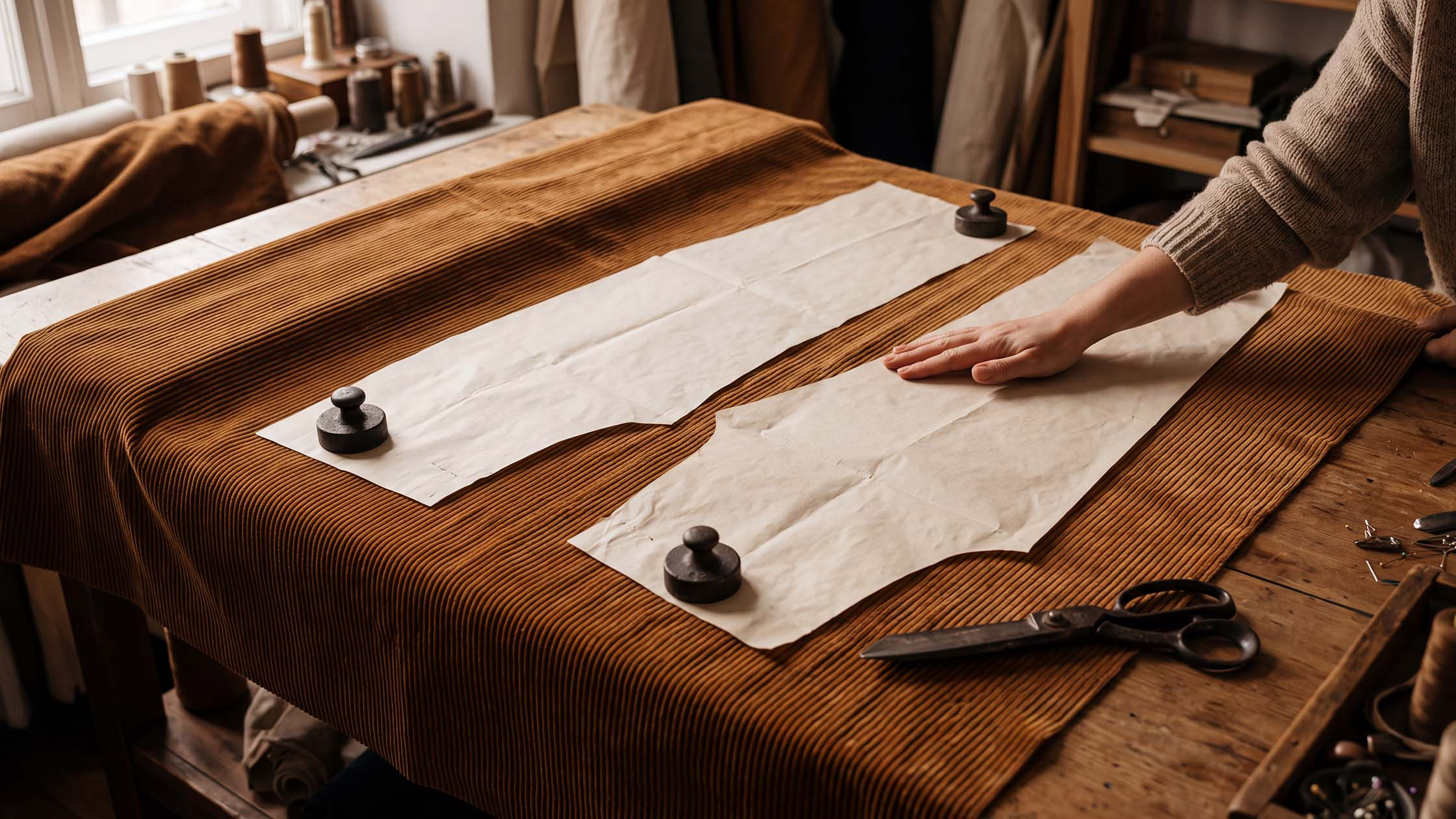
All the pieces of one garment must be cut in exactly the same direction. There is no room here for compromises or departures from the rule. Elegant corduroy clothing is usually cut against the nap to give a deep, matte colour. This makes the trousers look more expensive and more refined. Children's or work clothes are often cut with the nap, which makes them easier to clean and more resistant to wear. Choose one option and stick to it consistently for every small piece. This applies to the legs, and also to the waistband, pockets and belt loops. Turning even a small detail the other way will make it look like a patch from a different garment. Write this rule in capital letters in your project notebook.
Placing the trouser pattern pieces on the fabric step by step
Spread the whole fabric out flat on a large work table. Check the direction of the nap with your hand and mark it clearly with tailor's chalk on the wrong side. Lay out all the large pattern pieces so that their top edges point the same way. Keep to the grainline, which must run perfectly parallel to the selvedge of the fabric. Pin the front of the leg and then lay the back out in exactly the same orientation. Place the small pieces in the free spaces, keeping to the same strict direction. Check the placement of every paper piece twice before reaching for the scissors. Rushing at this stage always ends with an expensive fabric ruined. Accuracy and method are your best allies when working with demanding materials.
Saving fabric versus the risk of losing a uniform colour
Trying to save a dozen or so centimetres of fabric by turning one leg round is the most expensive mistake you can make in your sewing room. Laying pieces head to tail works with plain cotton but ruins corduroy projects. A garment cut in this way is fit only for the bin. You need to buy more fabric than the standard consumption tables in pattern catalogues give. An allowance of around twenty per cent is absolutely essential to place the pattern pieces correctly in one direction. The cost of an extra metre of fabric is nothing compared with the wasted time and a ruined main COUPON. Treat this surplus as an investment in the professional look of your work. Professional tailoring requires strict adherence to technological rules, even at the cost of using more material.
Strictly following the cutting direction guarantees perfect colour consistency across the whole outfit. A suitable allowance of fabric gives you peace of mind and confidence while you work.
Safe sewing and handling of thick fabrics in a home sewing room
Folded layers of autumn fabrics are a challenge for household multi-function machines. Preparing your equipment properly will protect you from skipped stitches and broken needles.
Choosing the right needles, presser feet and sewing thread
Thick weaves require sturdy cutting and sewing tools. A standard universal needle will quickly go blunt or break on the bulk of seams. Choose denim needles in size ninety to one hundred, which have a reinforced shank and sharp points. They will easily pierce several layers of stiff fabric in places such as where the waistband joins the crotch seam. Use strong polyester thread with increased resistance to snapping. Ordinary cotton thread often fails under the strains that arise when wearing fitted trousers. A walking foot will help you feed two layers of fabric evenly without them shifting against each other. Changing these few small elements will radically improve the quality and look of your stitches.
Pressing corduroy correctly without flattening the wales
Traditional pressing down with an iron will destroy the three-dimensional texture of the fabric in a fraction of a second. Pressing seams open calls for special techniques and great care. Always iron on the wrong side, using a soft base of a thick terry towel or a special tailor's brush. A soft base lets the wales sink into it, protecting them from being crushed. Use plenty of steam and minimal pressure from the iron. It is best to hold the iron just above the surface of the fabric and let the steam do all the work. If you have to press the right side, use a patch of leftover corduroy laid right side to right side of your project. This technique guarantees the perfect fluffiness and depth of colour on the finished garment.
Knowing the techniques of heat and mechanical treatment separates amateurs from professionals. Your sewing machine, properly set up, will cope with any thick weave.
FAQ: the most frequently asked questions about autumn sewing projects
Working with demanding materials raises many doubts at every stage of the creative process. Below you will find answers to the most common problems that come up in sewing rooms.
Can you combine corduroy with denim in one outfit?
Combining these two classic structures gives a wonderful contrast effect in everyday combinations. The smooth surface of denim shows off the three-dimensional quality of the wales beautifully. It is important to keep a balance in the proportions and weight of the two fabrics. Thin summer denim will look out of proportion beside thick winter corduroy. Choose materials of similar thickness so that the garments work well together in movement. In terms of colour, classic blue shades paired with warm browns and rusty reds work best. Such combinations recall the aesthetic of the nineteen-seventies, which regularly returns to the catwalks. Experiment boldly with these textures, creating unique and comfortable everyday outfits.
What to do if the legs you have already cut are a different shade?
Discovering this mistake after the pieces have been sewn together is a painful experience for any seamstress. Unfortunately there is no magic method to reverse the direction of the nap in a finished piece. Pressing against the nap or dry cleaning will not change the physical structure of how the fibres lie. The only solution is to cut the wrong piece again from leftover fabric. If you have no spare material, you must treat the project as work clothes or loungewear. This mistake is irreversible and permanently affects the look of the garment. It is an excellent if harsh lesson that teaches humility and forces you to check your pattern pieces carefully in future. Always verify the placement of the paper pieces before you make the first cut with the scissors.
How to care for the trousers you have sewn so they keep their original look?
Proper care extends the life of clothing sewn from pile fabrics. Before putting trousers in the washing machine, always turn them inside out and fasten all zips and buttons. This reduces the surface friction that destroys the delicate wales and causes colour to wear away at the edges. Use gentle liquid detergents and avoid a strong spin. Dry clothes hanging up, away from direct sources of heat and strong sunlight. Never use a tumble dryer, which permanently breaks the fibres and shrinks cotton. After drying, brush the fabric with a soft clothes brush along the direction of the nap. Such simple measures will let you enjoy deep colour and a flawless texture for many seasons.
Conscious care of the finished garment is just as important as the sewing itself. Your projects will delight for years if you follow the right washing procedures.